Micron is bowing out of the consumer DRAM business. A quick explainer. Micron is one of the “Big Three” in the DRAM space. Alongside Samsung and SK Hynix. The three giants, with a few other smaller players, were expected to generate close to $130bn in revenue this year, having closed out with about $97bn in 2024. Those three combined earn 90 – 92% of that revenue. Before you flip out, there is more to the tale of the tape. In 2024, Samsung and SK Hynix were at near parity, earning roughly 40% each of the market, + /-; at the end of the day, without splitting hairs, the two earn about 75% of the overall market revenue together.
Micron makes up somewhere between 9 – 15% of the remainder, depending on what source you consult. Leaving between 8 – 10% or so that is earned by the smaller players. While a very lopsided market, Micron exiting the space is not that big of a hit, although it will definitely lead to a rise in prices, a trend which was already underway. The smaller players include Nanya Technology Corporation, Winbond Electronics Corporation, and Powerchip Semiconductor Manufacturing Group. Each of these has some current limitation with its business model (regional supplier, value supplier for low-end budget applications, niche products for specialized applications) before they could mount up an effort to replace Micron. Still, that is the most likely scenario. I don’t think we are looking at a catastrophic choking of the supply chain in the DRAM market. But a cyclical supply constraint that will be corrected for by another competitor.
Supply-chain wise, these ODMs cover down on wafer fabrication, die preparation & testing, assembly & packaging. They then send these “packaged chips” out to the OEM’s, in the case of DIY retail parts, to your GSkill’s, Mushkin’s, Corsair’s, PNY’s, etc, (Micron’s own house-brand is Crucial so that brand may likely go away completely) and to SI’s.
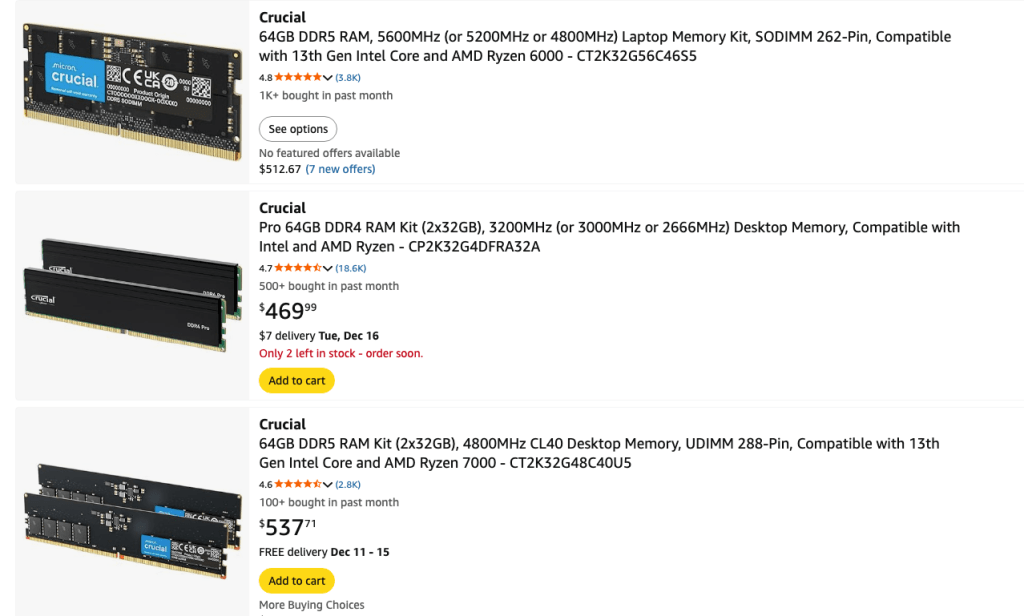
For the OEM’s, they mount them onto a PCB to create the memory modules in retail packaging that you buy from Amazon and Newegg. The SI’s, the Dell’s, Apple’s, Lenovo’s of the world, etc, place them directly in their own pre-built products.
So yes. A challenge to the supplier-side of the equation. A black-eye to the market. But a thing I think that will be recovered from. As I mentioned in an earlier piece somewhere, this is not a Tsunami, earthquake, pandemic, or nuclear plant meltdown that is creating an inability for the industry to make DRAM. But a contention of the available supply. And the industry wants to sell you memory modules. At scale. Not at the reduced demand that will be seen from $600 – $800 memory modules. They will figure it out. But we may all need to hunker down for a bit.
 Rounding Off Infinity