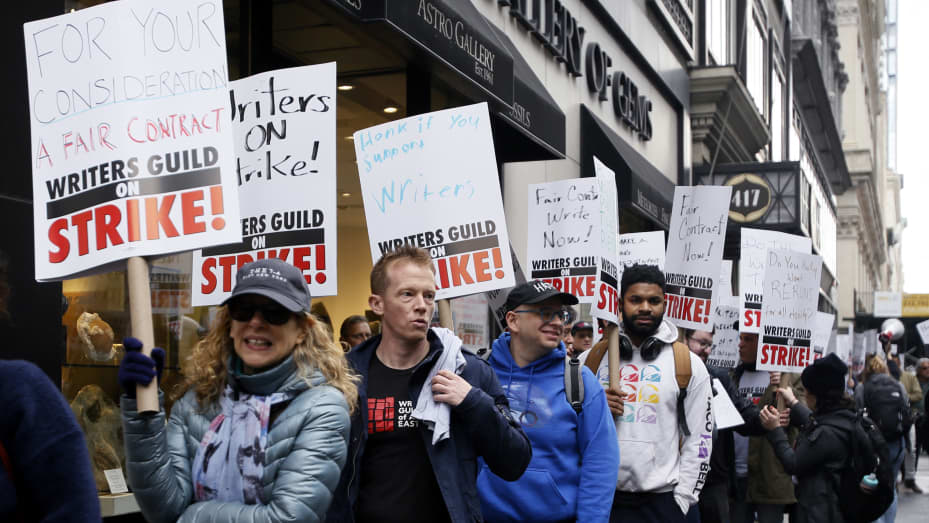
Ben Thompson posted an article on Stratechery this week that paints many parallels between the Hollywood Strike with things I have been calling out as warning signals. Potential impacts from subscription services that could have a disruptive impact on the gaming industry. The ongoing conversion of games to Software-as-a-Service, where it is taken beyond a tipping point in the games industry. It cuts across topics similar to the conversation we had on the Basement Radio Arcade podcast this past Wednesday (19 July 2023). Be mindful that my position is not the warning flare that most gamers in the PlayStation camp have been firing since Game Pass was launched. I feel this potential only became realized with the acquisition of Activision-Blizzard. A move that places Microsoft at parity with Sony by revenue, but gives them a significantly larger block of influence on the market by employee base. This is driven by not only the total studios it now owns, but also the distribution channels that it can access by leveraging its strengths in adjacent markets. While Ben’s article is an incredibly insightful one about the ongoing writer & actors strike in Hollywood, it hits the piano keys of almost everything I have been saying about the games industry for the past 18 months.
The first parallel between our streams of consciousness is in his pointing to the source of the Hollywood strikes being revolutionary changes in the technology basis of the industry having a knock-on effect to how money is earned; the business model. And therefore to how that money gets distributed, which eventually hits the talent. Other items will get dragged along with this industry dynamic over time. It evokes the question as to whether or not regulation will have to be imposed to keep things balanced between suppliers and the workforce. Suppliers stand to gain greater bargaining power with capabilities such as AI being used to regenerate performers’ likeness’ in voice and mo-cap, and the inevitable efficiencies that are dragged out of industries when they are heavily unionized (which is the natural societal response to an absence of regulation). I’ll draw pointers to this risk being a real concern when I later discuss the FTC’s revised draft guidelines on how it will police mergers & acquisitions in the future and the newly included focus on impact to employees and the labor market.
One thing that should be recognized and acknowledged, is that Activision-Blizzard will be bringing in less money as a P&L center. Normally, for a gamer to have access to the entire catalog of current ATVI games, you might pay $400 – $500. Now gamers will have access to that catalog for $204 a year, but the expense to make an individual title will remain the same. For now. And so on an annualized basis, ATVI will bring in fewer dollars total. This will result in the “shriveling pot”, a term both Thompson and I have used in our separate arguments. As the dwindling monetary resources take impact, those will not be felt by the executives at the top of the food chain. It’ll roll downhill.

The reaction to that will be to attempt to achieve operational excellence in project management and production costs. This may be done by increased automation, impacting lower-paid tiers of the workforce. I reduce expenses by not employing as many artists and testers by replicating iterative artist work with AI, & increasing the extent to which I lean on automated testing.
I also slow the creeping pace of salary increases, which I can now do because I occupy a larger bargaining block and have greater bartering power in the Human Resources / talent acquisition market. If you want more than what a Game Pass developer salary offer is, your option is to go shop yourself to the other 75% of the market. And once you are outside of the other 25% of that that is PlayStation…once you are shopping yourself to the remaining 50% of the market…you are shopping yourself to a portion that earns disproportionality less revenue. Good luck finding a higher salary there. And so the pace of salary increases winds up impacting the whole market by dragging it down. But there will still be opportunities there for the highly-paid talent that doesn’t have the stomach for entrepreneurship and wants a steady pay-check. That leaves the next lower-tier of talent to be the ones that take the Game Pass salary.
That’s not the insult many Game Pass fans will construe it to be. In any workforce, you have a 20-50-30 % split amongst your high talent / high pot employees, your middle, and then your lower tier that actually drag more out of the production than they put in. That middle 50 is really the essential part of the total workforce. You’re just going to see a gravimetric effect where more of that middle-50 talent tends to drift towards Game Pass over time. The residual knock-on effect of that will be reduction in the aggregate aspirational height of AAA projects that Game Pass will be able to take on, the velocity of development, and the degree to which an individual title can be QA’d in terms of defect discovery and defect removal.
Follow-on articles will continue the discussion of these parallels between the current Actors & Writers strike in Hollywood, and ongoing risks in the gaming industry.
[drafted on an iPad Pro 11″ 3rd generation using Upword]
 Rounding Off Infinity